
Maths of virality!🤳🏻 Reel Composer
The Engineer’s Lens
I have always sought comfort in the cold and quiet certainty of numbers.
I analyze existence through the framework of probability and statistics because numbers do not lie, and are brutally honest. Whether it is financial planning, career architecture, or the fragile complexity of human relationships, I construct my worldview on impartial evidence. I try to strip away the noise of emotion to find the fundamental principles beneath.
This approach has protected me. It has rarely failed me. Until I looked at social media.
Recently, I’ve watched a wave of people, my closest friends, my relatives, people I grew up with desperately clamoring to become "Influencers." And when I look at the incentives, I understand why. It is a path that offers an escape from the grind. It doesn’t demand cracking competitive exams or seeking government clearance. It promises success label, fame, and a staggering amount of money at the top, and sometimes even overnight success.
But when I looked closer, I saw a chaotic landscape divided by predictable archetypes.
The men usually gravitate towards
- moto-vlogging
- gaming
- reaction videos.
- tutorials and memes pages
The women often gravitate towards
- lifestyle vlogging
- skincare routines
- makeup
- dance trends.
The Personal grudge
I have always hated the concept of "being a creator" (not the person, but the job description). My mind would scream "Power Law Distribution!" at every viral success story.
My personal biases reinforced this skepticism. As a guy, I am naturally blind to the appeal of skincare and lifestyle vlogs (I barely have a skincare routine myself, and no life at all).
But even the "male-centric" content baffled me.
-
Gaming: Why would I watch someone else play when I can play the game myself? I only watch gameplay for specific hacks or combos I can use, pure utility.
-
Reaction Videos: Why do I need a middleman to react to a video I can watch directly?
-
Moto-vlogging: I don't drive (my parents were protective of their only child, so I never learned). While I view driving as a life skill, I would still rather ride than watch someone else ride.
To me, consumption without utility felt like a runtime error. I only consumed content for two reasons: High-Octane Entertainment (like Anime) or Learning (Tutorials).
When Instagram Reels dropped, I swore I’d never use it. I hated TikTok; I hated the infinite scroll.
The Hypocrisy & The Observation
Eventually, the algorithm won. I found myself doom-scrolling memes just like everyone else. But while others were enjoying the show, I was stress-testing the logic. It became less about enjoyment and more of a mental exercise: Why is this engaging?
I never criticized my friends who pursued this as a career. I watched some hit 50k followers in youtube, others get millions of views, expanded their network. But as an engineer, I noticed a concerning trend in the underlying economics:
- Low ROI: Almost no one was living off ad revenue or brand collabs.
- High Risk: The income was peanuts and unstable compared to their predictable career salaries.
- Survivor Bias: The "successful" ones weren't just making videos, they were running businesses! selling courses or products.
The "Chaos" Problem
What triggered my OCD wasn't the content, it was the lack of methodology.
I saw one friend investing heavily in cameras and gear, spending hours editing, mastering voiceovers, and trying to mimic their favorite influencers. But it was all imitation, not design.
Others were brute-forcing the algorithm. Success seemed random.
As an engineer, I hate chaos. I hate inefficiencies. I saw people working hard with no guarantee of output. So, I decided to stop analyzing from the sidelines. I decided to get my hands dirty.
I launched an experiment to answer one question: If I apply System Design principles to this chaos, is it really worth it?
The Mathematics of The Feed
To solve this problem, I had to stop looking at Instagram as a social network and start treating it as a Stochastic System.
I ignored the "Algorithm". People obsess over
- hashtags
- posting times
- trending audio.
To me, those are just noise variables. If you strip away the UI, the recommendation engine is simply a Probability Filter.
I modeled the entire career of an "Influencer" using three fundamental mathematical concepts.
1. The Bernoulli Trial (The Ticket)
Every time you post a video, you are initiating a Bernoulli Trial. It is a random experiment with exactly two possible outcomes:
- ✅ Success (1): The video goes viral (captures the "Tail Event").
- ❌ Failure (0): The video flops (gets 200 views).
Let p be the probability of a single video going viral.
For a normal person, p is incredibly low.
Let’s conservatively say p = 0.01 (1%).
Most people approach this emotionally. They pour their heart into one video (one trial), upload it, and get depressed when it fails.
Mathematically, this is irrational. If you only conduct one trial with p=0.01, your probability of failure is 99%.
2. The Binomial Distribution (The Volume)
This is where the "Consistency" advice actually comes from, it’s not about discipline; it’s about statistics.
If I post n videos, the probability of getting at least one viral hit (P) is calculated as:
Let's plug in the numbers assuming p = 0.01 (1% chance per video):
-
The "Perfectionist" (n=1):
You spend a month making 1 perfect video.
P = 1 - (0.99)¹ = 0.01
(1% Chance) -
The "High Frequency" (n=30):
You post daily for a month.
P = 1 - (0.99)³⁰ = 0.26
(26% Chance)
By simply increasing n (Volume), I increase my odds of success by 2600%. I realized that if I wanted to win, I didn't need to be lucky. I just needed to buy more lottery tickets.
3. The Power Law (The Payoff)
Why does one viral video matter? Because social media returns follow a Pareto Distribution (Power Law), not a Normal Distribution (Bell Curve).
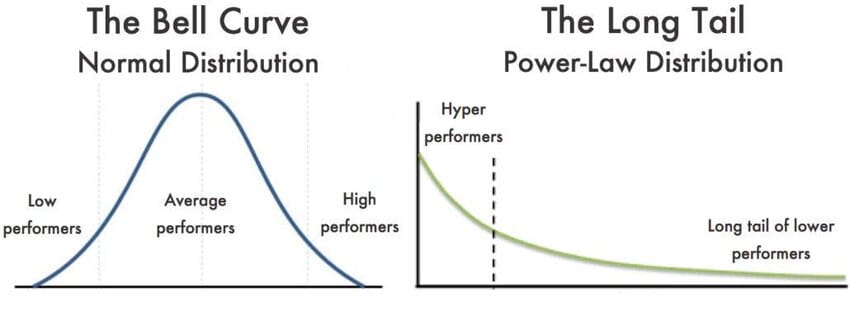
In a corporate job, returns are Linear. You work 10% harder; you get a 10% bonus. On the internet, returns are Asymptotic:
Capturing just one Tail Event outweighs the failures of 100 previous attempts. This is why "cringe" creators succeed, when they survive long enough to hit the tail.
The Optimization Problem: Quality vs. Volume
This brought me to the Engineer's Deadlock.
Technical Note: Input vs. Output
Before solving this, we must distinguish between Effort and Result.
- Quality (Input): The hours, script depth, and editing effort you put in.
- Probability p (Output): The algorithm's likelihood of promoting the content.
p = f(Quality)
This function is Logarithmic, not Linear.
Doubling your effort (Quality) does NOT double your success rate (p).
To maximize my Expected Value (E), I needed to maximize Volume (n). However, because resources are finite, Volume and Quality are inversely proportional.
If I increase Volume (n) by spamming, Quality drops significantly, so my Output Probability (p) crashes to zero.
If I chase "Perfect" Quality to marginally increase (p), the time cost ensures my Volume (n) crashes to zero.
Most people fail because they compromise on one side of the equation:
The Spammers
High n, but p ≈ 0.
Result: Noise
The Artists
High p, but n ≈ 1.
Result: Obscurity
I needed a third option.
I needed to maintain the "High Quality" signal (which creates Authority and Credibility) but produce it at "Spam Volume" speeds.
I didn't need a video editor. I needed a Factory.
This is where my domain expertise came in. I realized that "Quality" in the tech niche isn't about cinematic lighting or smooth transitions. It's about Information Density and Visual Clarity.
And I knew that anything logical like explaining code or systems, could be defined programmatically.
So, I stopped editing. I opened my IDE! let me present...
Reel Composer
The Director's Studio
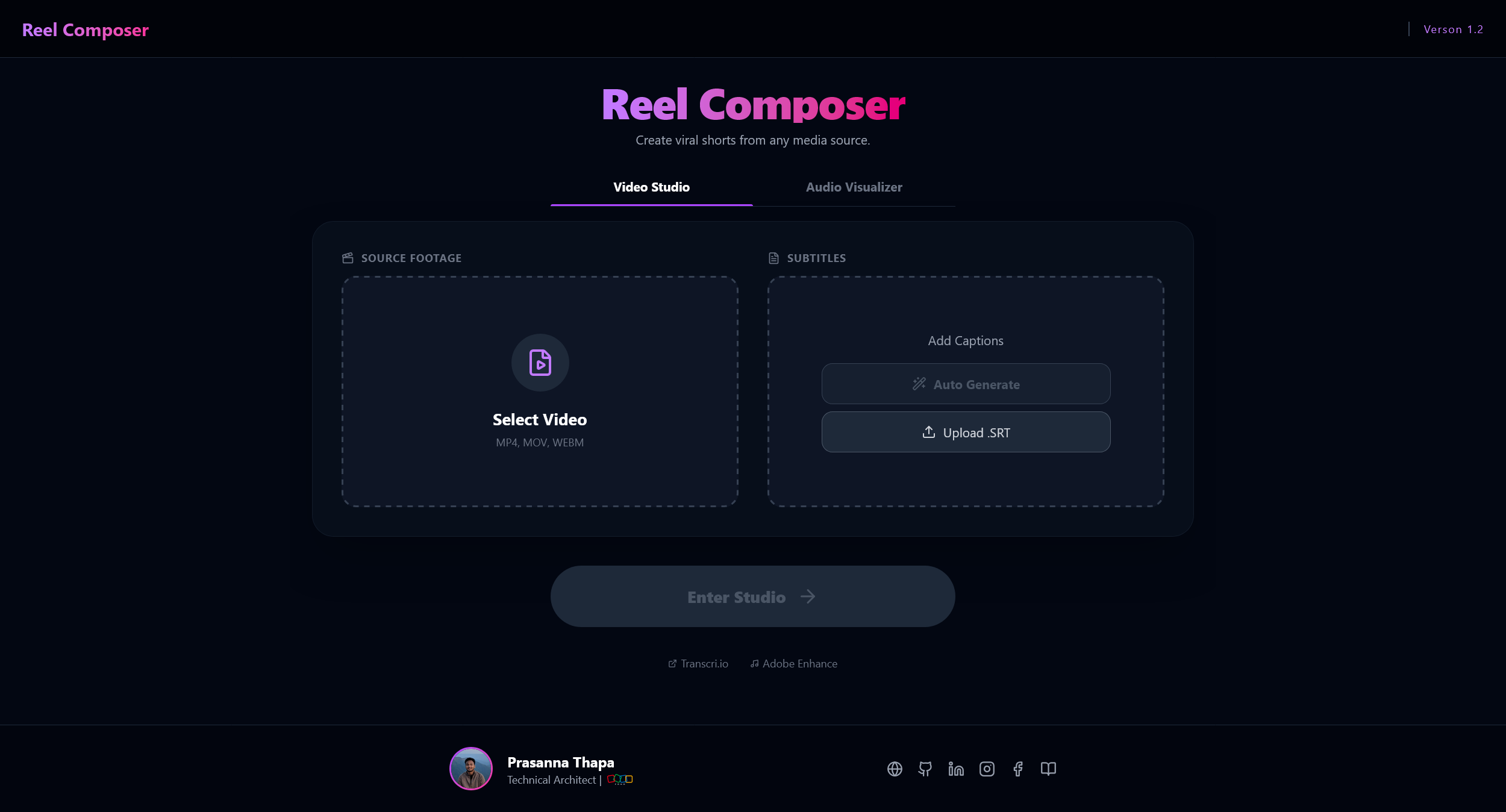
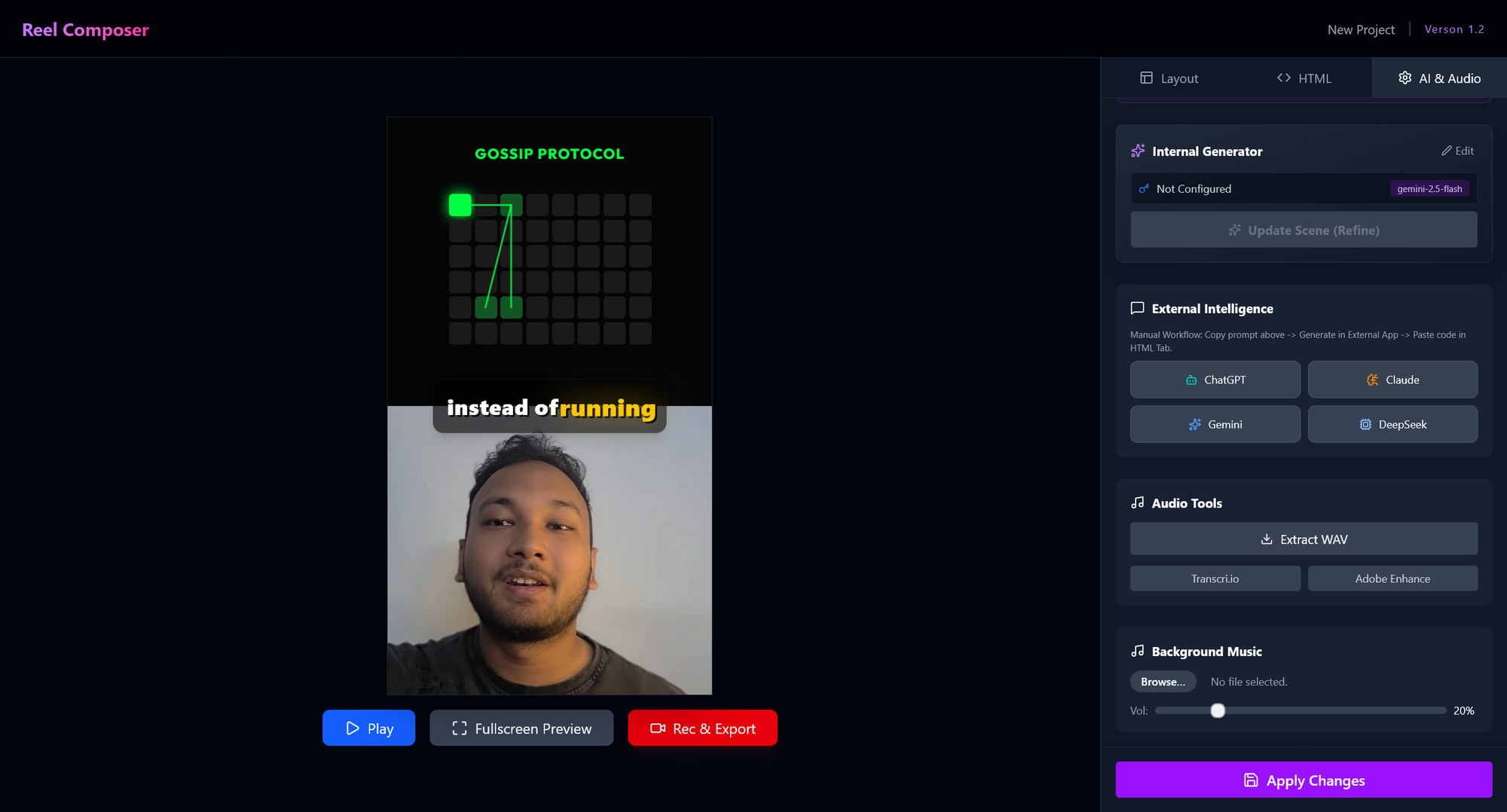
Reel Composer is a "Director's Studio" that transforms raw talking-head footage into high-retention "Edutainment" content.
It leverages Google Gemini to intelligently analyze your transcript and generate synchronized, broadcast-quality HTML5/GSAP animations that overlay your video.
The Philosophy: Quantity > Perfectionism
"In the world of algorithms, Volume is Leverage."
To grow on social media, you must understand the Statistics of Virality.
1. The Probabilistic Reality
Going viral is a probabilistic event. It is a lottery where every video you post is a ticket.
- Low Volume: Posting 1 "Perfect" video a month = 12 chances/year.
- High Volume: Posting 1 "Good Enough" video a day = 365 chances/year.
2. The Credibility Trap
Usually, increasing volume means sacrificing quality. However, low-quality content hurts your authority.
- The Dilemma: High-end motion graphics build trust but take days to edit in After Effects.
- The Solution: Reel Composer automates the "Credibility Layer."
3. Automating Authority (The Core Insight)
LLMs are notoriously bad at generating video pixels directly (Sora is expensive and hallucinates). But LLMs are excellent at generating code.
Reel Composer bridges the gap by treating Video as Code. It generates pure HTML/CSS/GSAP animations that are:
- Iterable: Don't like the color? Just change the CSS.
- Glitch-Free: No weird AI artifacts or melting faces.
- Lightweight: Runs in the browser, no heavy rendering farms needed.
⚡ Features
1. Context-Aware Animation
Most tools just add subtitles. Reel Composer understands context. If you say "The server crashed," it doesn't just write the text; it generates a red, glitching terminal animation overlaid on the screen. It uses Gemini 2.0 to direct the visual narrative based on your spoken words.
2. The "Director's" Editor
This isn't a timeline editor; it's a Code Editor. You get a split-screen view: Your video on the left, the generated HTML/CSS on the right. If the animation isn't perfect, you don't nudge keyframes—you tweak the code (or ask the AI to tweak it for you).
3. Surgical Auto-Captions
Upload your video, and the system automatically generates an .SRT file. But unlike standard captions, these are tied to the animation triggers, ensuring that your visuals land exactly when the beat drops.
4. Zero-Hallucination Rendering
Because we are using DOM manipulation (HTML5) instead of diffusion models (like Sora), the text is always legible, the charts are always accurate, and the physics are always consistent.
🚀 The Experiment Continues
I built this not just as a tool, but as a proof of concept: Can we engineer luck? By reducing the cost of "High Quality" production to zero, we can flood the zone with high-signal content, lets see!
First 6 Days
1 - 6 January 2026
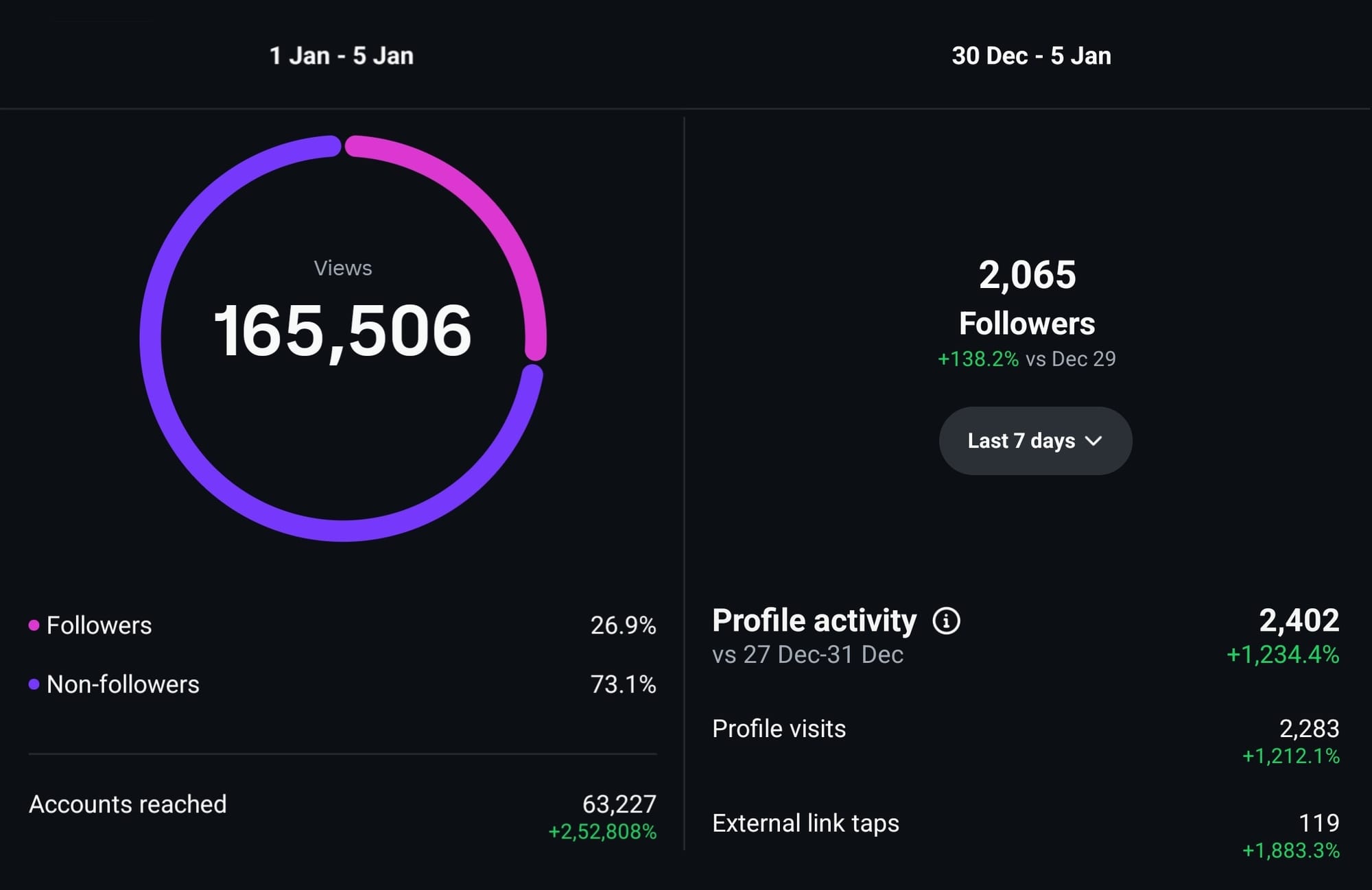
Wow! I absolutely did not expected this! My Instagram followers rarely changed from last 3-4 years despite being public account.
It went from 450 followers to 2000+ in couple of days! from 500-1000 views to 165,506 views!
Here's the viral post on Instagram.
The Relativity of Success (Moving the Goalpost)
Here is the final property of the Power Law: It scales logarithmically.
Right now, a 50k view video (Merkle Trees) looks like a massive Tail Event. It is a 15x outlier compared to my average.
But as I keep increasing my trials (n), the probability of hitting a true outlier (1M+ views) increases. When that happens, the entire scale shifts:
- Today: 50k is a Tail Event 🚀
- Next Month: 50k becomes a Strong Signal 📈
- Next Year: 50k becomes Random Noise 📉
This is the Compound Effect of Volume. By consistently playing the game, you don't just get more views; you redefine what "success" looks like.
If the hypothesis holds, my current ceiling will eventually become my floor.
And if I ever reach that scale, I will finally be able to answer the ultimate question:
Is there actual leverage in being an "influencer"?
Is there intrinsic value in the attention itself, or is it just fancy marketing that people do to ultimately build a business or sell courses?
I guess we will find out.
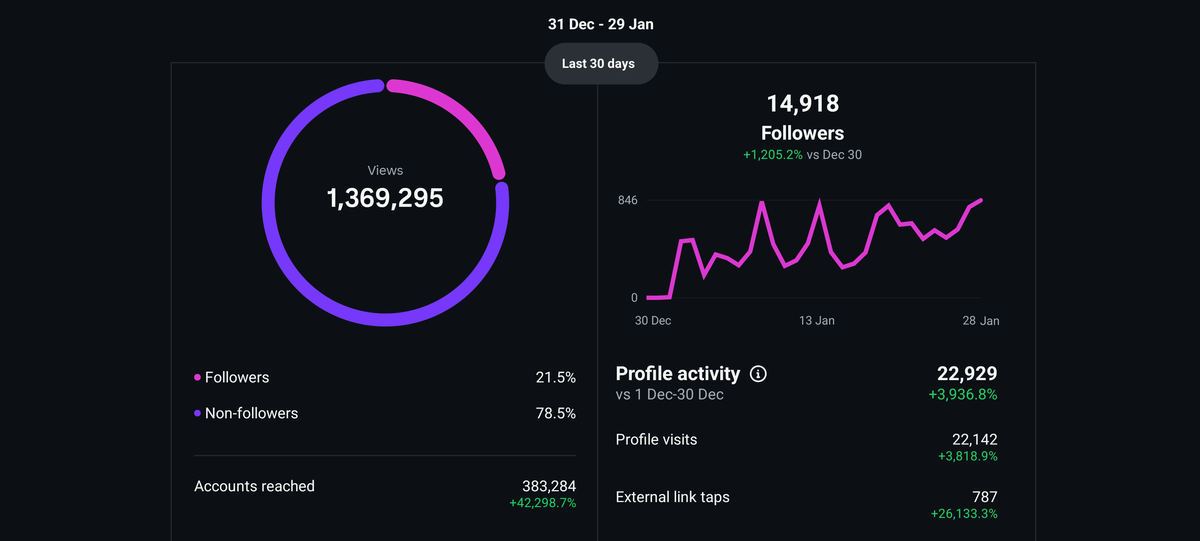
Update! Full 30 Days
1 - 30 January 2026
The Mathematics of Consistency
Most "gurus" tell you to post daily because "the algorithm likes it." That is superstition. I post daily because of Statistical Significance.
1. Why 30 Videos?
(Central Limit Theorem)
In probability theory, n = 30 is the magic number. It is the threshold where the Central Limit Theorem (CLT) kicks in.
When you have fewer than 30 data points (n < 30), your data is volatile. A video might flop not because the content is bad, but because the sample variance is too high.
Takeaway: By hitting 30 videos, I moved my experiment from "Anecdotal Evidence" to "Statistical Fact."
2. Volume Redefines Probability
We view "going viral" as luck. But mathematically, luck is just a function of volume. If your "Hit Rate" (p) is 1%, and you post once, you will fail 99% of the time.
But as you increase Volume (n), the probability of Total Failure drops to zero.
This is the Bernoulli Trial at scale. If you buy enough lottery tickets, eventually, probability forces a win.
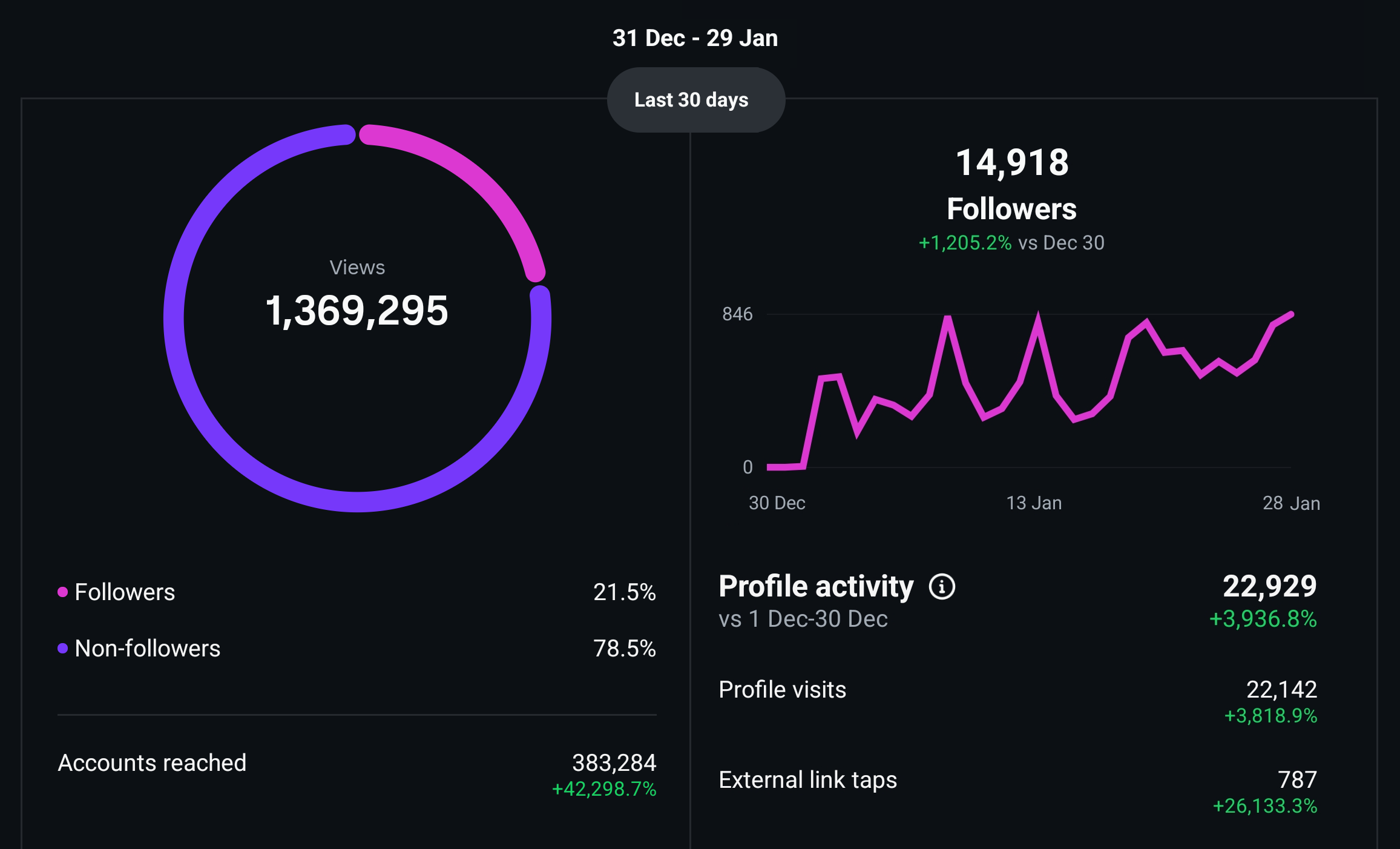
Conclusion: I am not "lucky" that I got 1.4M views. I simply ran enough trials to force the math to work.